Coffee Machine Parts FAQ
Answers for coffee-machine component sourcing and engineering.
Buyer-focused guidance on custom coffee-machine parts, micro-orifice inserts, flow control, materials, inspection, prototyping and stable volume production.
Coffee Machine Parts FAQ
Start with the questions that affect function, quality and supply
These answers are written for purchasing, engineering and quality teams evaluating a custom coffee-machine parts supplier. Project-specific requirements are confirmed against the drawing and actual operating conditions.
Supplier fit & RFQ
01What custom coffee-machine parts can Jiechi manufacture?
+
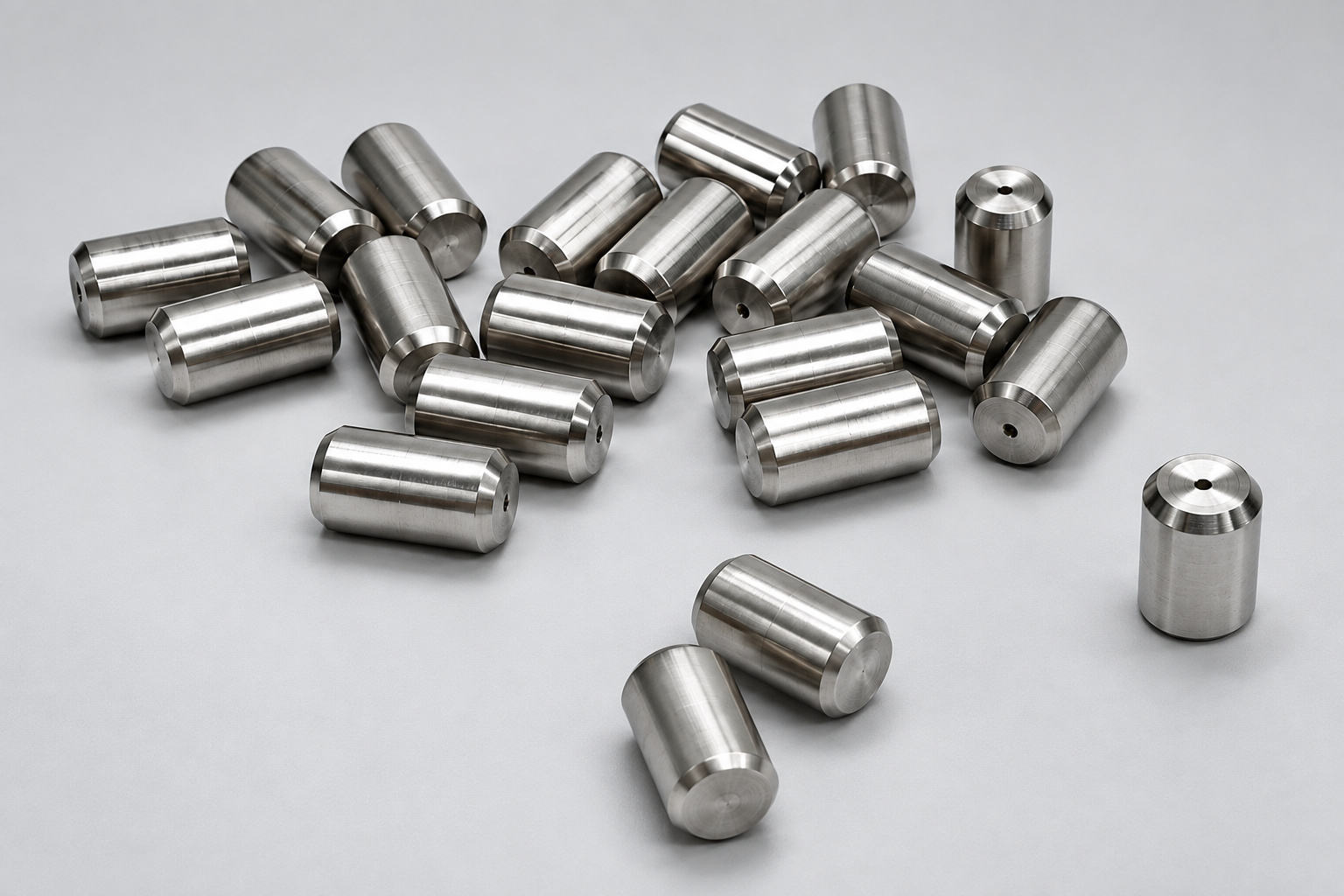
We manufacture drawing-based precision components including micro-orifice air-inlet inserts, flow-control inserts, stepped shafts, multi-hole distribution plates, cross-drilled valve sleeves, threaded steam distribution caps, hose-barb fittings, valve plungers, retaining rings, drive shafts and ball-tip valve sleeves.
02Are these coffee-machine components standard spare parts?
+
No. The parts shown are representative custom components manufactured to customer drawings, samples or controlled technical requirements. We do not present them as universal replacement parts.
03What information is needed for a coffee-machine parts quotation?
+
Please provide a 2D drawing or 3D model, material, annual quantity, critical dimensions, functional requirements, surface treatment, inspection expectations and target date. Application details such as water, steam, air or milk contact help us review risk correctly.
Micro-orifice & flow performance
04Can Jiechi manufacture a 0.11 mm micro-hole repeatedly?
+
Our published coffee-machine case uses a 0.11 mm nominal center micro-hole. Feasibility and repeatability are confirmed project by project against material, depth, tolerance, burr limits, inspection method and production volume.
05Why does an air-inlet micro-hole affect milk-frothing consistency?
+
The air-inlet feature meters air into the frothing system. Variation, contamination or blockage can change airflow and therefore milk-foam texture and stability, so the orifice is treated as a function-critical feature.
06How do you control burrs and blockage risk in micro-hole parts?
+
We plan drilling conditions, tool control, deburring, cleaning and inspection around the drawing and functional risk. Acceptance criteria must be defined with the customer because hole size, depth, material and downstream cleaning conditions change the correct method.
07Can you manufacture espresso-machine flow restrictors or gicleurs?
+
Yes. We can review custom micro-orifice inserts, calibrated flow restrictors and gicleur-type turned components. Required orifice size, length, medium, pressure, target flow and verification method should be included in the RFQ.
08How are micro-holes and small orifices inspected?
+
Depending on geometry and risk, validation may use optical measurement, microscope inspection, vision measurement and controlled sampling or full inspection. The method and acceptance rule are agreed before production release.
09Can airflow or liquid-flow performance be verified?
+
Functional verification is defined with the customer. We can combine dimensional and optical evidence with customer-side testing or a project-specific flow test when the medium, pressure, fixture, limits and correlation method are clearly specified.
Materials, food contact & surface treatment
10Which materials are available for coffee-machine precision parts?
+
Typical materials include 316L and other stainless steels, brass, aluminum, steel and copper alloys. Final material and grade must follow the drawing, corrosion environment, temperature, mechanical function and regulatory requirements.
11Can you support food-contact coffee-machine components?
+
Yes, when the customer identifies the contact zone, destination market, material specification, cleaning method and required declarations. Material and process documentation must be agreed during quotation; we do not assume one generic food-contact rule applies to every market.
12Can material certificates and batch traceability be provided?
+
Material certificates, supplier records and batch traceability can be included when specified in the RFQ and purchase requirements. The exact document set should be confirmed before material is ordered.
13Can passivation or other surface treatments be coordinated?
+
Yes. Passivation and other approved surface treatments can be coordinated through qualified process partners when specified. Appearance, corrosion resistance, cleanliness, masking and inspection requirements should be defined on the drawing or specification.
Quality, prototypes & serial production
14How do you reduce leakage and sealing problems in valve or fitting parts?
+
We focus on sealing diameters, cone or seat geometry, threads, surface condition, burr control and mating dimensions. If pressure-decay, leak or assembly testing is required, the test medium, pressure, duration and acceptance limit must be agreed.
15Are prototypes made to the same standard as mass-production parts?
+
Every prototype is planned with production intent. We use production-level process planning and inspection logic so approved samples can transition into stable batch manufacturing instead of remaining one-off samples.
16What are the MOQ and lead time for custom coffee-machine parts?
+
MOQ and lead time depend on material availability, geometry, tooling, inspection, surface treatment and annual demand. Send the drawing and target quantity for a project-specific response rather than relying on a generic number.
17How do you maintain consistency between approved samples and repeat orders?
+
We control the drawing revision, process route, inspection plan, first-article result and production records. Any change affecting function, material or inspection should be reviewed and approved before implementation.
18What quality records can accompany a shipment?
+
Project requirements may include first-article reports, dimensional inspection records, material documentation, process records and controlled shipment release evidence. The required package is defined before order confirmation.
Confidentiality & supply continuity
19How are confidential coffee-machine projects protected?
+
We can sign a mutual NDA before detailed technical review. Public case studies omit customer names, proprietary drawings, identifiable structures and confidential operating data.
20Can Jiechi support a second-source or localization project?
+
Yes. We can evaluate drawings, samples and functional requirements to develop a controlled China-based manufacturing route, with validation steps agreed before serial supply.
Blog
Contact / RFQ
Every prototype is built with production intent.
From the first sample, we apply production-level process planning, quality controls and inspection logic—not a one-off prototype approach. Share your drawing, functional requirements and target volume so our engineering team can plan a reliable path to stable production.
Mutual NDA available before detailed technical review.
 WhatsApp
 LINE
 WeChat