Quick Answer
Manufacturing a Ø0.11 mm micro-hole in a 316L stainless steel coffee machine component is not simply a drilling problem. The real challenges are controlling burrs, preventing hole blockage, maintaining airflow consistency, and achieving repeatable results in production.
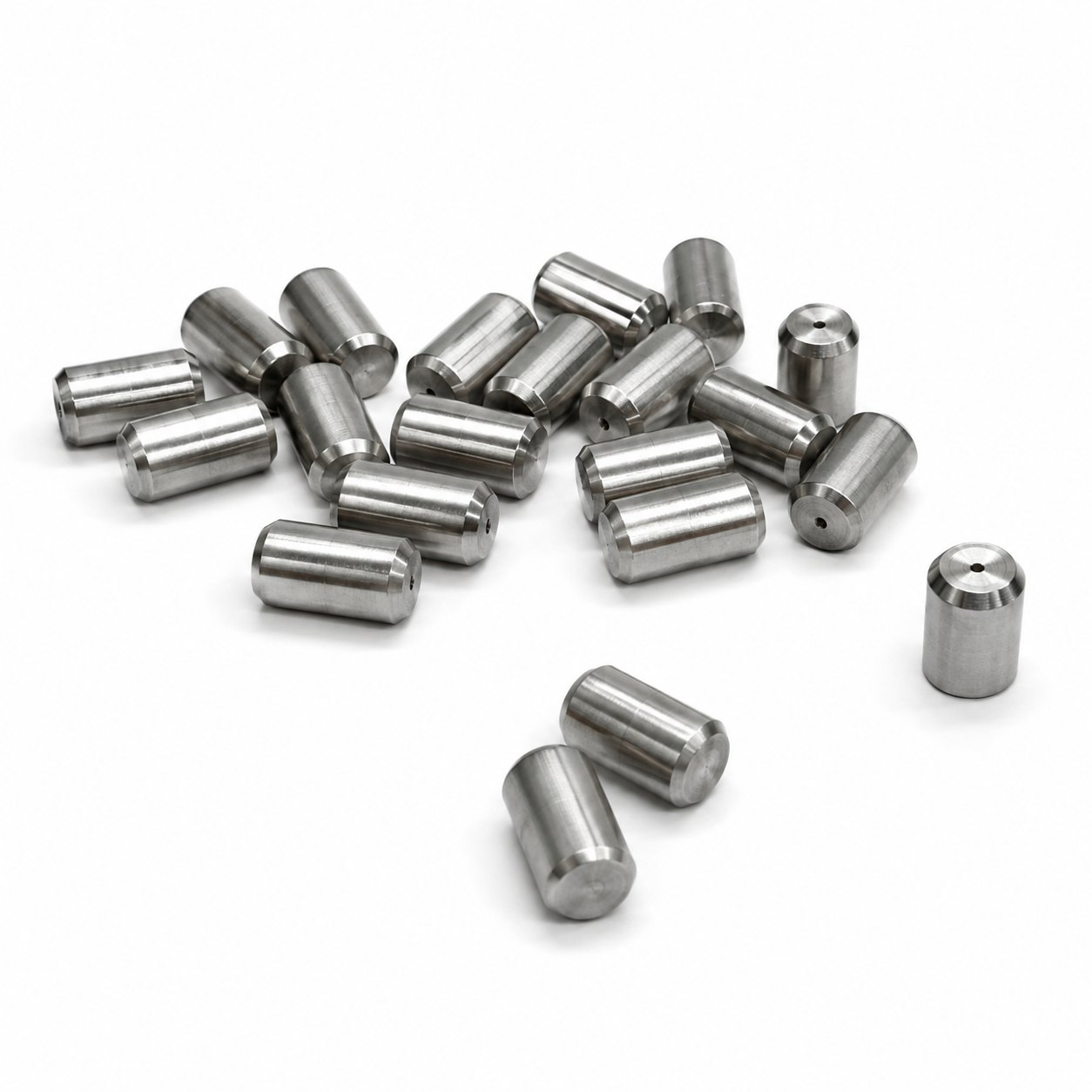
In one coffee machine project, Suzhou Jiechi Precision developed a Swiss-type CNC machining process for a 316L precision insert with a Ø0.11 mm micro-hole and a dimensional tolerance of approximately ±0.01 mm. After several months of process development and testing across multiple hole-size ranges, the final solution significantly improved consistency and reduced the customer's need for replacement parts.
For the material challenges behind this project, read our 316L stainless steel CNC machining guide. Our guide to micro-hole blockage causes and controls explains how burrs, chips and cleaning affect an open passage.
Key Takeaways
- Material: 316L stainless steel
- Micro-hole diameter: Ø0.11 mm
- Dimensional tolerance: approximately ±0.01 mm
- Process: Swiss-type CNC turning combined with micro-hole machining
- Main challenges: burrs, blockage, tool stability and airflow consistency
- Development period: approximately three months
- Multiple hole sizes between approximately Ø0.10 mm and Ø0.20 mm were evaluated
- The project later expanded into more than 100 additional precision parts
Why Is a Ø0.11 mm Hole Difficult to Manufacture?
A Ø0.11 mm hole is 110 micrometres in nominal diameter.
At this scale, conventional machining problems become much more serious.
Small variations in tool condition, cutting parameters, material properties or burr formation can affect whether the hole functions correctly.
For coffee machine air and steam systems, the hole is not simply a geometric feature.
It directly affects:
- airflow
- pressure
- milk frothing performance
- steam consistency
- system reliability
A component may look dimensionally acceptable but still fail in actual use if the hole is partially blocked or airflow is inconsistent.
The Customer's Original Problem
The customer had been experiencing a long-term problem with a small coffee machine component used in an air or steam-related system.
The previous manufacturing method produced inconsistent results.
Typical issues included:
- micro-hole blockage
- unstable airflow
- burr formation
- inconsistent hole geometry
- frequent replacement of the component
Because reliability was insufficient, the customer supplied multiple spare components with each machine.
The problem had existed for several years.
The objective was therefore not simply to manufacture a cheaper part.
The real objective was to improve process stability and reduce the customer's maintenance burden.
Why 316L Stainless Steel Was Challenging
316L stainless steel is widely used in food, beverage, medical and fluid-handling applications because of its corrosion resistance.
However, it is not an easy material for extremely small precision features.
When machining 316L, manufacturers may encounter:
- work hardening
- heat buildup
- tool wear
- burr formation
- poor chip evacuation
These problems become more significant when the feature being produced is only around Ø0.11 mm.
For micro-hole machining, even a small burr can partially block the hole.
That means the machining process must control not only the nominal diameter, but also the condition of the hole entrance, exit and internal passage.
Our Development Approach
Instead of treating the part as a standard turned component, we treated it as an engineering development project.
The development process lasted approximately three months.
Multiple machining conditions and hole-size ranges were evaluated.
Approximately 20 specifications or process combinations within the Ø0.10 mm to Ø0.20 mm range were tested during development.
The evaluation focused on four major factors.
1. Hole Diameter Stability
The hole had to remain within the required dimensional range consistently.
A single successful sample was not enough.
The process needed to remain stable across repeated production.
2. Burr Control
Micro burrs can reduce the effective flow area even when the measured diameter appears acceptable.
Controlling burr formation therefore became one of the key process requirements.
3. Hole Blockage
At very small diameters, contamination, chips or deformation can partially block the passage.
Inspection had to confirm that the hole remained open and functional.
4. Airflow Consistency
For this application, dimensional inspection alone was not sufficient.
The component also needed consistent functional performance.
The manufacturing process therefore had to support repeatable airflow from part to part.
Why Swiss-Type CNC Machining Was Used
Swiss-type CNC machines are especially suitable for small, slender and high-precision turned components.
Compared with conventional turning, Swiss machining provides strong support close to the cutting area, helping reduce deflection during machining.
For this type of coffee machine component, Swiss machining offered several advantages:
- stable machining of small-diameter components
- good concentricity
- repeatable dimensional control
- efficient multi-operation machining
- suitability for medium- and high-volume production
However, the machine itself does not solve the micro-hole problem.
Tool selection, cutting parameters, burr control, inspection and process validation remain critical.
Inspection Was as Important as Machining
For very small holes, standard visual inspection is often insufficient.
The project therefore required microscopic inspection and controlled sampling.
Important inspection items included:
- hole opening condition
- burr condition
- visible blockage
- critical dimensions
- repeatability across samples
For precision fluid and airflow components, functional consistency should be considered together with dimensional inspection.
A part can meet a basic dimensional requirement while still performing poorly in real operating conditions.
The Final Result
After process development and validation, the final manufacturing solution significantly improved component consistency.
The customer had previously supplied ten spare inserts with each machine because of reliability concerns.
After the machining process was stabilized, the number of spare inserts supplied with each machine was reduced from ten to zero.
The successful development also strengthened the customer's confidence in the supplier's engineering capability.
The cooperation later expanded to more than 100 additional precision components.
This project illustrates an important point:
For difficult precision parts, manufacturing value is not created by quoting the lowest unit price.
It comes from solving the engineering problem behind the drawing.
Typical Applications for Similar Micro-Hole Components
Precision micro-hole turned components can be used in:
- coffee machine steam systems
- milk frothing systems
- air intake systems
- fluid control systems
- precision valves
- miniature nozzles
- gas control components
- pressure regulation systems
- food and beverage equipment
For these applications, hole diameter, burr control, concentricity and flow consistency can all affect final product performance.
What Information Should Be Included in an RFQ?
For micro-hole or precision turned components, customers should provide as much technical information as possible.
Useful information includes:
- 2D drawing
- 3D model
- material specification
- critical dimensions
- dimensional tolerances
- hole diameter
- surface finish requirements
- annual quantity
- prototype quantity
- inspection requirements
- functional requirements such as airflow or pressure
For components used in fluid, gas or steam systems, functional operating conditions are especially valuable.
These may include pressure, temperature, media and expected flow characteristics.
Frequently Asked Questions
Can you machine holes smaller than Ø0.20 mm?
Micro-hole machining is possible, but feasibility depends on the material, hole depth, geometry, tolerance and required production quantity.
A technical review is recommended before quotation.
Is 316L suitable for coffee machine components?
316L stainless steel is commonly used where corrosion resistance and cleanliness are important.
However, the correct material depends on the specific operating environment and functional requirements.
Can you guarantee zero burrs?
For extremely small precision features, the correct approach is to define an acceptable burr condition and inspection method.
The manufacturing process can be optimized to minimize burrs, but requirements should be clearly defined on the drawing or inspection standard.
What is the typical prototype lead time?
For suitable precision CNC projects, sample production can often be arranged after drawing review and process confirmation.
Lead time depends on material availability, tooling and inspection requirements.
Can you manufacture other coffee machine components?
Yes.
Suzhou Jiechi Precision focuses on precision turned components including inserts, fittings, pins, shafts, valve-related parts, fluid-control components and other small circular precision parts.
Precision CNC Turning for Difficult Components
Suzhou Jiechi Precision specializes in precision CNC turned parts and Swiss-machined components.
Our focus is not simply machining parts according to drawings.
We work on manufacturing problems involving:
- small diameters
- tight tolerances
- micro holes
- concentricity
- burr control
- difficult stainless steels
- functional consistency
Industries served include coffee equipment, automotive, textile machinery, fluid control and industrial equipment.
If you are developing a precision turned component with a difficult machining feature, send us your drawing and technical requirements for an engineering review.