Quick Answer
CNC turning and Swiss turning can both produce high-quality cylindrical precision parts, but they are optimized for different part geometries and production requirements.
Conventional CNC turning is often suitable for short, rigid parts, prototypes and components that do not require extensive support during machining.
Swiss turning is usually better for small-diameter, long, slender or highly detailed parts because the material is supported close to the cutting area. This can improve stability, concentricity and repeatability.
For precision components with tight tolerances, micro-holes, multiple features or higher production quantities, Swiss-type CNC machining may offer significant advantages.
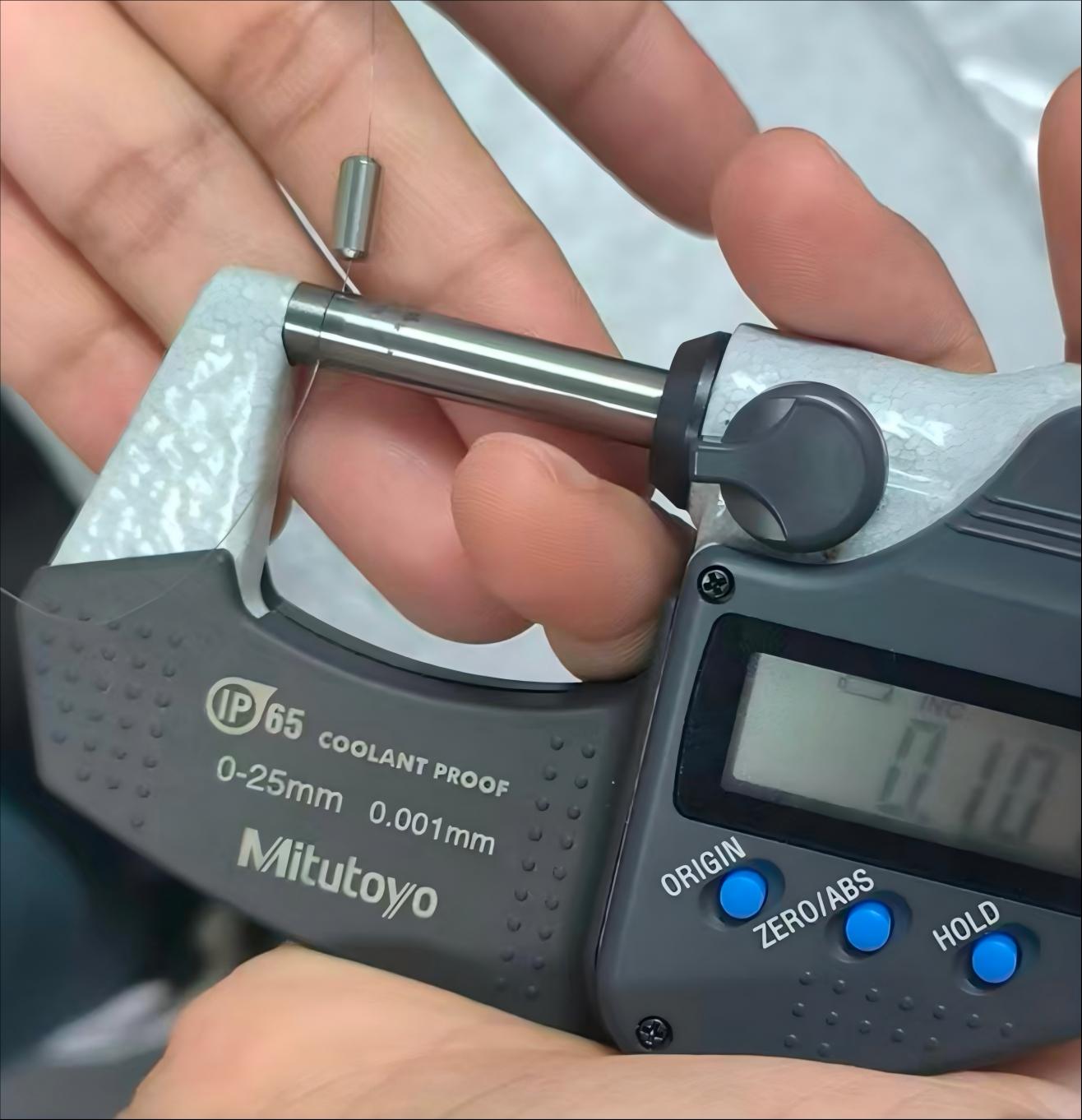
Read the Ø0.11 mm micro-hole coffee machine component case study for a specific application. For stainless steel parts, review the 316L machining challenges and process controls alongside the machine choice.
Key Takeaways
- CNC turning is flexible and suitable for many general turned components.
- Swiss turning is especially effective for small-diameter and slender parts.
- Swiss machines support the bar stock close to the cutting tool.
- This support can reduce deflection and improve repeatability.
- Swiss turning is well suited to complex parts requiring multiple operations.
- Conventional CNC turning may be more economical for simpler parts or lower quantities.
- The best process depends on geometry, tolerance, material, quantity and inspection requirements.
What Is CNC Turning?
CNC turning is a machining process in which the workpiece rotates while cutting tools remove material.
It is widely used to produce cylindrical components such as:
- shafts
- pins
- bushings
- spacers
- fittings
- sleeves
- threaded parts
- valve components
Modern CNC lathes can perform multiple operations, including:
- turning
- facing
- drilling
- threading
- grooving
- boring
Some machines also include live tooling for milling and cross-drilling.
CNC turning is therefore one of the most flexible manufacturing methods for rotational parts.
What Is Swiss Turning?
Swiss turning is a specialized form of CNC turning originally developed for small and highly precise components.
The key difference is how the workpiece is supported.
In a conventional CNC lathe, the workpiece extends from the chuck.
In a guide-bushing Swiss-type machine, the bar stock moves through a guide bushing, and the cutting action occurs close to that support point. Some Swiss machines also support guide-bushing-free operation; the appropriate mode depends on the part.
This reduces unsupported material length during machining.
The result can be improved stability when machining:
- small diameters
- long slender parts
- thin features
- tight tolerances
- complex geometries
Swiss machines often include multiple tool stations, live tooling and secondary spindles, allowing many operations to be completed in a single setup.
CNC Turning vs Swiss Turning: Main Differences
1. Workpiece Support
The biggest difference is workpiece support.
With conventional CNC turning, a longer unsupported section of material may extend from the chuck.
This can cause deflection when machining small or slender parts.
Swiss turning supports the material close to the cutting zone.
This makes it more suitable for parts where rigidity is limited.
2. Part Diameter
Swiss turning is particularly effective for small-diameter components.
Typical applications include:
- miniature shafts
- pins
- precision inserts
- fittings
- connectors
- medical components
- fluid-control parts
Conventional turning is also capable of producing small parts, but Swiss machines often provide better process stability when dimensions become very small.
3. Length-to-Diameter Ratio
Parts with a high length-to-diameter ratio are more difficult to machine on conventional lathes because they can bend or vibrate.
Swiss turning reduces this problem because the cutting tool works close to the guide bushing.
For long slender parts, this can significantly improve:
- dimensional accuracy
- concentricity
- surface finish
- repeatability
4. Number of Operations
Conventional CNC turning may require additional setups for complex parts.
Swiss-type machines often combine:
- turning
- drilling
- milling
- cross-drilling
- threading
- grooving
- back-working
This allows complex components to be completed with fewer setups.
Reducing setup changes can also reduce accumulated positioning error.
5. Production Volume
Swiss turning is often highly efficient for medium- and high-volume production.
Once the machine is properly set up, automatic bar feeding and multiple tool stations can support stable production.
However, setup and programming may be more complex.
For very low-volume or simple parts, conventional CNC turning may be more economical.
6. Cost
Swiss turning is not automatically cheaper.
The actual cost depends on:
- material
- geometry
- tolerance
- quantity
- cycle time
- setup complexity
- tooling
- inspection requirements
For a simple short part, conventional turning may offer better value.
For a complex small component requiring multiple operations, Swiss turning may reduce total cost by combining operations and improving production consistency.
When Should You Choose Conventional CNC Turning?
Conventional CNC turning may be the better choice when:
- the part is relatively short and rigid
- the geometry is simple
- production quantity is low
- prototype flexibility is important
- the diameter is relatively large
- only a few machining operations are required
- tolerance requirements are moderate
It is also useful when frequent design changes are expected during development.
When Should You Choose Swiss Turning?
Swiss turning is often preferred when:
- the part diameter is small
- the part is long and slender
- tight tolerances are required
- concentricity is critical
- multiple machining operations are needed
- the component includes small holes or cross-features
- production volume is medium or high
- repeatability is essential
It is particularly effective for precision components used in:
- coffee equipment
- valves
- pumps
- sensors
- automotive systems
- medical devices
- fluid-control systems
- textile machinery
Why Swiss Turning Can Improve Concentricity
Concentricity is important when several cylindrical features must remain aligned.
Examples include:
- shafts
- valve spools
- inserts
- nozzles
- precision sleeves
- sensor bodies
When a part is machined in multiple setups, alignment errors can accumulate.
Swiss machines can often complete several features within one controlled setup.
This helps reduce the need for repositioning and can improve feature-to-feature alignment.
However, machine capability alone is not enough.
Concentricity also depends on:
- tooling condition
- bar quality
- guide bushing setup
- cutting parameters
- inspection method
Swiss Turning for Micro-Hole Components
Swiss turning can be especially useful when a precision turned component also contains very small holes.
For example, Suzhou Jiechi Precision developed a 316L coffee machine component with a Ø0.11 mm micro-hole.
The challenge was not only producing the hole diameter.
The process also had to control:
- micro burrs
- blockage
- hole repeatability
- airflow consistency
The Swiss-type machining platform provided stable support for the small turned component, while micro-hole machining and inspection required additional process development.
This demonstrates an important principle:
Swiss turning is a manufacturing platform, but successful precision production still depends on process engineering.
Example: Small Precision Fluid-Control Component
Consider a small stainless steel component used in a fluid-control system.
The part may require:
- external turning
- internal drilling
- cross holes
- threads
- grooves
- tight concentricity
- surface finish control
If each feature requires a separate setup, total production time and positioning risk increase.
A Swiss-type CNC machine may complete many of these operations in one machining cycle.
This can improve repeatability and reduce handling.
Tolerance: Which Process Is More Accurate?
It is incorrect to say that Swiss turning is always more accurate than conventional CNC turning.
Both processes can achieve high precision.
Accuracy depends on:
- machine condition
- tool selection
- part geometry
- material
- fixturing
- programming
- process control
- inspection
Swiss turning becomes especially advantageous when the part geometry itself creates stability problems.
In other words, the process should be selected based on the engineering challenge, not simply on the machine name.
Material Considerations
Both CNC turning and Swiss turning can machine many materials, including:
- 303 stainless steel
- 304 stainless steel
- 316L stainless steel
- carbon steel
- brass
- aluminum
- engineering plastics
- selected alloy steels
Material machinability should always be considered together with geometry.
For example, 316L stainless steel can produce work-hardening, heat and burr-control challenges.
When combined with small diameters or micro-holes, process planning becomes even more important.
Questions to Ask Before Choosing the Process
Before deciding between conventional turning and Swiss turning, consider:
- What is the minimum part diameter?
- What is the overall part length?
- What is the length-to-diameter ratio?
- Which dimensions are functionally critical?
- Is concentricity important?
- Are cross holes or milled features required?
- What material will be used?
- What is the annual production volume?
- Are prototypes required first?
- What inspection method is required?
A supplier should evaluate these factors before recommending a process.
Frequently Asked Questions
Is Swiss turning only for high-volume production?
No.
Swiss turning can also be used for prototypes and lower quantities when the geometry requires it.
However, its economic advantage generally becomes stronger when production quantities increase.
Is Swiss turning more expensive than CNC turning?
Not always.
Swiss machining may have higher setup complexity, but it can reduce secondary operations and improve production efficiency for complex small parts.
What types of parts are best suited to Swiss machining?
Typical examples include small shafts, pins, fittings, connectors, inserts, valve components, sensor bodies and other precision cylindrical parts.
Can Swiss machines produce cross holes and milled features?
Yes.
Many modern Swiss-type machines include live tooling and secondary spindles, allowing cross-drilling, milling and other operations.
Can both processes machine 316L stainless steel?
Yes.
Both conventional CNC turning and Swiss turning can machine 316L.
The correct choice depends on part geometry, tolerance and quantity.
Which process should I choose for my part?
The best approach is to review the drawing, material, tolerance and production quantity before selecting the manufacturing process.
How We Select the Right Turning Process
Suzhou Jiechi Precision does not recommend Swiss machining simply because it is more advanced.
We select the process according to the actual part.
The review typically considers:
- diameter
- length
- tolerance
- material
- number of features
- concentricity
- production quantity
- inspection requirements
Our focus is to find a stable and commercially practical manufacturing process.
For difficult small-diameter turned parts, we can evaluate conventional CNC turning, Swiss-type machining or a combination of machining processes based on the drawing.
Send us your 2D drawing, 3D model and production requirements for process review.