Quick Answer
316L stainless steel is widely used for precision CNC machined parts because of its corrosion resistance, durability and suitability for food, beverage, medical and fluid-handling applications.
However, 316L is more difficult to machine than many common steels. Typical challenges include work hardening, heat generation, tool wear, burr formation and poor chip evacuation.
For precision turned parts, especially components with small diameters, tight tolerances or micro-holes, stable process control is essential.
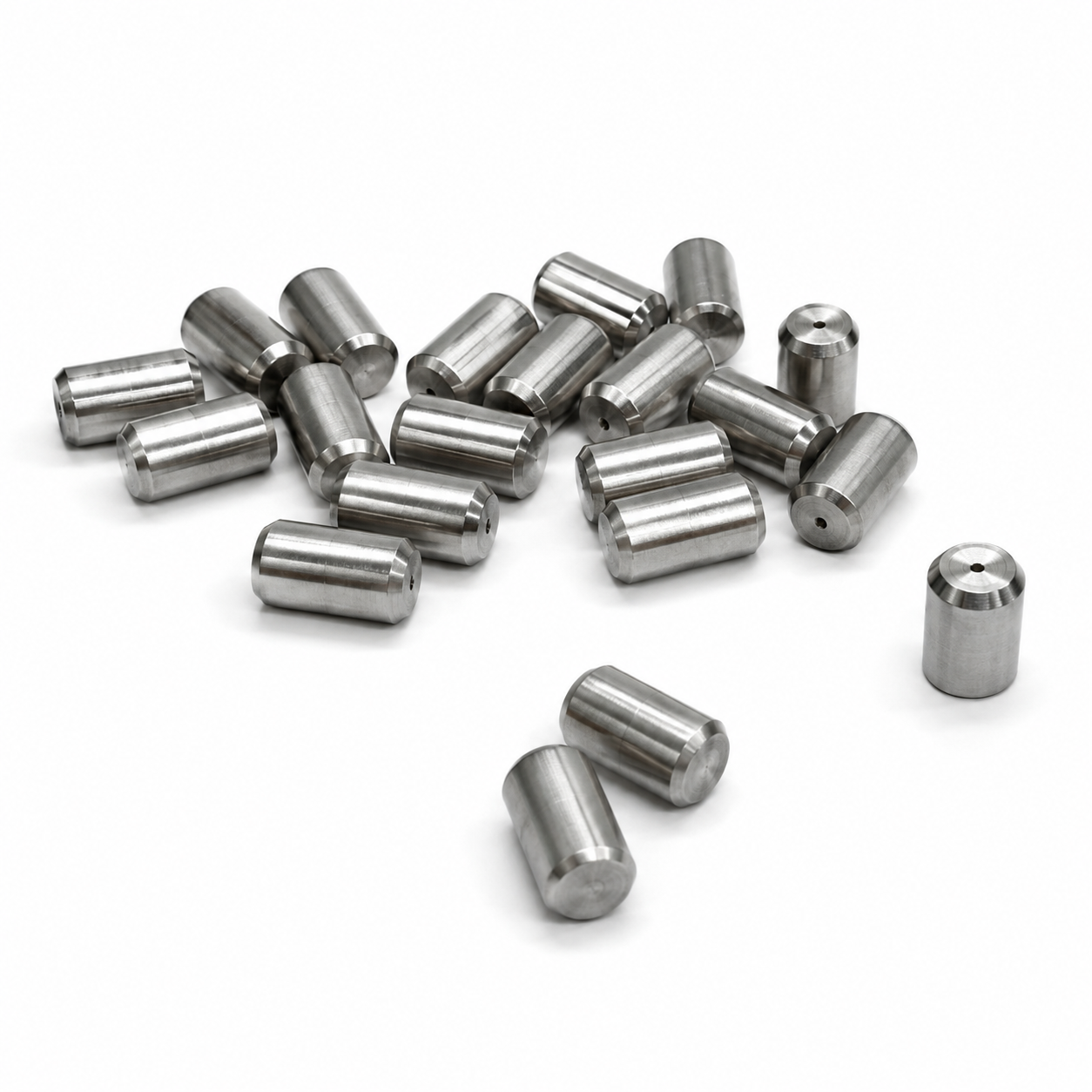
Suzhou Jiechi Precision uses CNC turning and Swiss-type machining to manufacture 316L precision components for applications such as coffee machines, fluid-control systems, industrial equipment and other demanding assemblies.
See these challenges in the Ø0.11 mm micro-hole coffee machine component case study. For process selection, compare CNC turning and Swiss turning for small precision parts.
Key Takeaways
- 316L provides excellent corrosion resistance.
- It is commonly used in food, beverage and fluid-control applications.
- Machining 316L requires careful control of heat, chip formation and tool wear.
- Burr formation becomes critical when small holes or precision flow passages are involved.
- Swiss-type CNC machining can be effective for small and high-precision turned components.
- Dimensional inspection alone may not be enough for functional parts.
- Process stability is often more important than achieving one successful sample.
What Is 316L Stainless Steel?
316L is a low-carbon version of 316 stainless steel.
It contains chromium, nickel and molybdenum, which provide strong corrosion resistance, particularly in environments involving moisture, chemicals or food-processing conditions.
The “L” refers to its lower carbon content.
This characteristic helps reduce the risk of corrosion around welded areas and makes 316L suitable for many demanding applications.
Common industries include:
- food and beverage equipment
- coffee machines
- medical devices
- chemical equipment
- marine systems
- valves and pumps
- fluid-control equipment
- industrial automation
For precision components, 316L is often chosen when both corrosion resistance and mechanical strength are required.
Why Is 316L Stainless Steel Difficult to Machine?
316L offers excellent performance in service, but those same material properties create machining challenges.
1. Work Hardening
316L can harden quickly during machining.
If cutting parameters are incorrect or the tool repeatedly rubs the surface instead of cutting effectively, the material near the cutting zone can become harder.
This increases cutting forces and accelerates tool wear.
For precision parts, unstable tool wear can directly affect dimensional consistency.
2. Heat Generation
316L has relatively poor thermal conductivity compared with many carbon steels.
More heat remains near the cutting zone instead of dissipating through the material.
This can cause:
- faster tool wear
- dimensional drift
- poor surface quality
- reduced tool life
For small precision components, even minor thermal variation can affect tolerances.
3. Difficult Chip Control
316L often produces long and continuous chips.
Poor chip evacuation can cause:
- scratches on finished surfaces
- tool interference
- instability during automatic machining
- damage to small features
Reliable chip control is especially important during Swiss-type machining and high-volume production.
4. Burr Formation
316L can produce difficult burrs around drilled holes, cross holes and small machined features.
For conventional mechanical components, a small burr may be manageable.
For a fluid-control or coffee machine component, however, a burr may:
- restrict airflow
- affect sealing
- block a small passage
- change functional performance
This makes burr control a critical part of process design.
How Can 316L Machining Stability Be Improved?
There is no single setting that solves every 316L machining problem.
The correct process depends on part geometry, tolerance, quantity and functional requirements.
However, several principles are important.
Stable Tooling
Sharp and suitable cutting tools are essential.
Tool condition must be monitored carefully because worn tools can cause dimensional variation, poor surface finish and increased burr formation.
Correct Cutting Parameters
Cutting speed, feed rate and depth of cut must be balanced.
Parameters that are too aggressive may accelerate tool wear.
Parameters that are too conservative may increase rubbing and work hardening.
The objective is stable material removal rather than simply the highest cutting speed.
Effective Coolant Control
Coolant helps manage heat, lubricate the cutting area and improve chip evacuation.
For small components and deep or micro features, coolant delivery can become especially important.
Process Sequencing
The machining sequence can affect final accuracy.
For example, the order of turning, drilling, finishing and deburring operations may influence concentricity, burr condition and dimensional stability.
A good CNC process should consider the complete part rather than optimizing each operation independently.
When Is Swiss-Type CNC Machining Suitable for 316L?
Swiss-type CNC machining is particularly suitable for small, long and high-precision components.
Unlike conventional CNC turning, Swiss machines support the material close to the cutting point.
This helps reduce deflection and improves machining stability.
Typical advantages include:
- improved concentricity
- stable small-diameter machining
- multiple operations in one setup
- high repeatability
- efficient production for medium and large quantities
Typical 316L Swiss-machined components include:
- pins
- shafts
- fittings
- inserts
- valve components
- miniature connectors
- fluid-control parts
- coffee machine components
However, Swiss machining alone does not guarantee quality.
Tooling, cutting parameters, inspection and process validation remain essential.
316L for Coffee Machine Components
Coffee machines contain many components exposed to water, steam, pressure and food-related environments.
Typical precision parts may include:
- steam system components
- milk frothing components
- fittings
- inserts
- valve-related parts
- nozzles
- small shafts
- air-control components
For these parts, manufacturers must consider more than dimensional tolerance.
Important factors can include:
- corrosion resistance
- surface cleanliness
- burr control
- sealing performance
- airflow consistency
- pressure resistance
316L is therefore commonly considered for demanding coffee equipment components.
Case Study: Ø0.11 mm Micro-Hole in 316L
One of our more demanding 316L projects involved a precision coffee machine component with a Ø0.11 mm micro-hole.
The application required consistent airflow and reliable long-term performance.
The main manufacturing challenges included:
- extremely small hole diameter
- burr control
- blockage prevention
- repeatability
- airflow consistency
The project required approximately three months of process development.
Multiple process conditions and hole-size ranges between approximately Ø0.10 mm and Ø0.20 mm were evaluated.
After the process was stabilized, component consistency improved significantly.
The customer's need for replacement components was reduced, and the project later expanded into more than 100 additional precision components.
This example shows why 316L machining should be treated as a process engineering problem rather than simply a quotation based on drawing dimensions.
Inspection Requirements for 316L Precision Parts
The inspection plan should reflect how the component functions.
Typical inspection methods may include:
- micrometer measurement
- optical measurement
- microscope inspection
- dimensional gauges
- surface inspection
- sample verification
For components with micro-holes or flow passages, additional functional checks may also be necessary.
A part can meet dimensional specifications and still fail if a hole is partially blocked or a burr affects flow.
The inspection method should therefore be agreed according to actual application requirements.
Common Tolerances for CNC Machined 316L Parts
The achievable tolerance depends on:
- part diameter
- geometry
- machining length
- feature type
- machine capability
- inspection method
- production volume
Tight tolerances can be achieved on suitable features, but it is important not to apply unnecessarily tight tolerances to every dimension.
Over-specifying tolerances can increase:
- machining time
- tool wear
- inspection cost
- rejection risk
A better approach is to identify genuinely functional dimensions and control those dimensions accordingly.
How to Request a Quote for 316L CNC Parts
A complete RFQ helps the manufacturer evaluate feasibility accurately.
Customers should ideally provide:
- 2D drawing
- 3D model
- material grade
- critical tolerances
- annual quantity
- batch quantity
- surface finish
- heat treatment if required
- inspection requirements
- packaging requirements
- functional conditions
For fluid-control components, customers should also provide relevant information such as:
- operating pressure
- temperature
- fluid or gas type
- flow requirements
- sealing requirements
These details can significantly affect the recommended manufacturing process.
Frequently Asked Questions
Is 316L harder to machine than 304 stainless steel?
In many machining situations, 316L can be more demanding because of its work-hardening behavior, heat generation and chip-control characteristics.
The actual difficulty depends on the component geometry and machining process.
Can 316L be used for food and coffee machine components?
Yes.
316L is widely used in applications requiring corrosion resistance and cleanliness, including food and beverage equipment.
Final material selection should still consider the specific operating environment.
Can 316L be used for micro-hole components?
Yes, but small holes require careful control of tooling, burrs, blockage and inspection.
The smaller the feature, the more important process stability becomes.
Is Swiss machining suitable for 316L?
Yes.
Swiss-type CNC machining can be very effective for small-diameter precision components and complex turned parts.
Can you machine prototype quantities?
Prototype production is possible for suitable projects.
Feasibility, tooling requirements and lead time depend on geometry, material and inspection requirements.
Precision 316L CNC Machining Support
Suzhou Jiechi Precision focuses on precision CNC turned parts and Swiss-machined components.
Our experience includes manufacturing challenges involving:
- 316L stainless steel
- small diameters
- micro-holes
- tight tolerances
- concentricity
- burr control
- airflow consistency
- fluid-control applications
We support applications in coffee equipment, automotive, textile machinery, industrial equipment and precision fluid-control systems.
If your 316L component involves difficult tolerances or functional machining challenges, send us your drawing and technical requirements for review.